






The current trend in skin treatments is to become beautiful in a way that looks natural, as if nothing has been done. Perhaps that is why an increasing number of people are seeking out Juvelook, which naturally improves skin concerns. If you are considering a Juvelook treatment, you may be wondering where to get it done, as the dosage, number of sessions, and prices vary widely from clinic to clinic.
What is the appropriate dosage for Juvereuk? Why do some hospitals specify the amount in cc, while others specify it in vials? There is a marketing secret hidden here. To help you choose a hospital based on clear criteria, we will thoroughly answer your questions regarding Juvereuk dosage.
Why do some hospitals label it as cc while others label it as vial? There is a marketing secret hidden here.
Jubelook capacity and price aren’t everything.
If you look at clinics offering Juvereuk procedures, you can see that there are significant price differences despite the identical treatment. It is easy to assume that since the procedure is essentially the same, choosing the cheapest option is the answer. However, while it may appear affordable at first glance, there are often cases where it is actually more expensive than elsewhere upon closer inspection. What exactly is the hidden reason behind this?
When comparing information, price is not the only thing you need to examine carefully. The details regarding the procedure listed alongside it are also an essential check. Clinics that actively promote low prices generally fall into one of two categories: either they only list the number of sessions, such as “how much for how many,” or they indicate the volume solely in cc units, like 1cc, 2cc, or 6cc.

First, let’s address the number of sessions required. The Juvelook procedure is an injection treatment performed by directly injecting a solution into the skin. Therefore, the quality of the solution has a significant impact on the outcome. In other words, if the solution is not properly prepared, it is difficult to expect any results, no matter how many times you receive the treatment. Since there are no results, it is tantamount to throwing away money; how then can we possibly call it affordable?
Juveloc capacity, the key is the vial
You might be asking this question: I understand that the products used for the Juvelook procedure are the same at any clinic, so why is there a difference in the solution? That is correct. After all, Juvelook is the product name itself. Unless it is a counterfeit, the exact same product is used everywhere, but the problem arises during the preparation process.
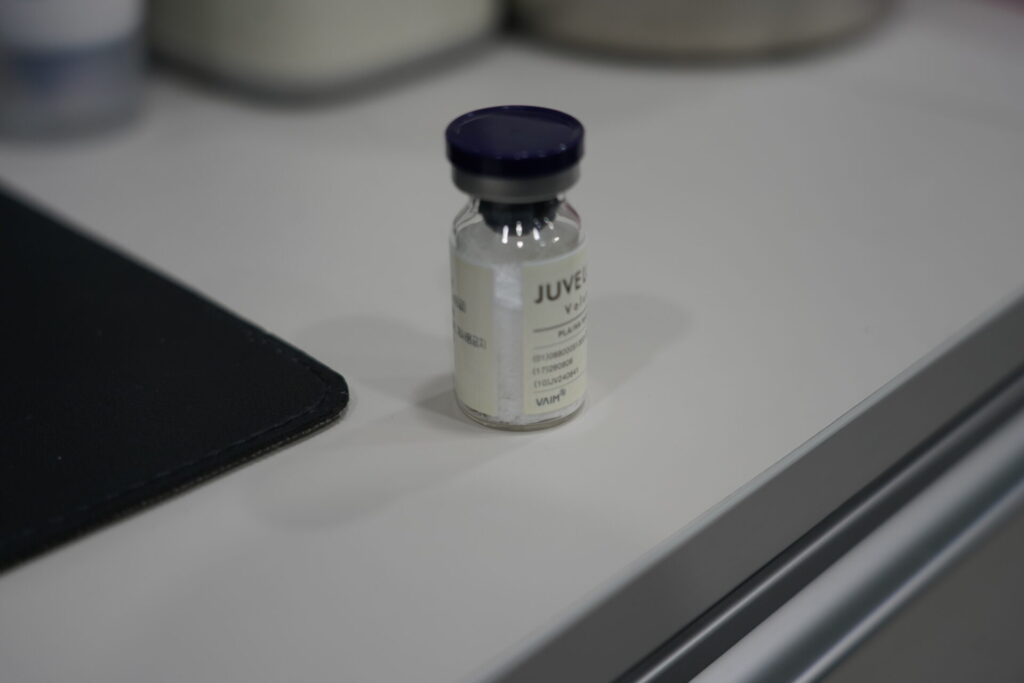
When Juvérluc is first distributed to hospitals, it is in powder form, not liquid. Since powder cannot be injected directly into the skin, it is dissolved in a liquid, such as saline solution or hyaluronic acid, before being used in procedures. This process is called hydration. While only rough guidelines are provided regarding the ratio in which saline solution and raw Juvérluc should be mixed, the matter is essentially left to the discretion of the hospital. This is why there are differences in the actual content among hospitals.
The hydration process also serves as an answer regarding volume units. cc is a unit primarily used for liquids. This implies that volume notations such as 1cc or 2cc are generally based on the state after the hydration process. Consequently, it is impossible to know exactly how much Juveluc powder has been added to the solution. After all, whether you add a spoonful of salt to 100mL of water or 100L of water, the fact remains that it is ‘saltwater.’ If the concentration of the solution is too diluted, the effectiveness of the procedure will naturally be reduced.
Whether you add a spoonful of salt to 100ml of water or 100L of water, the fact that it is ‘saltwater’ remains the same.
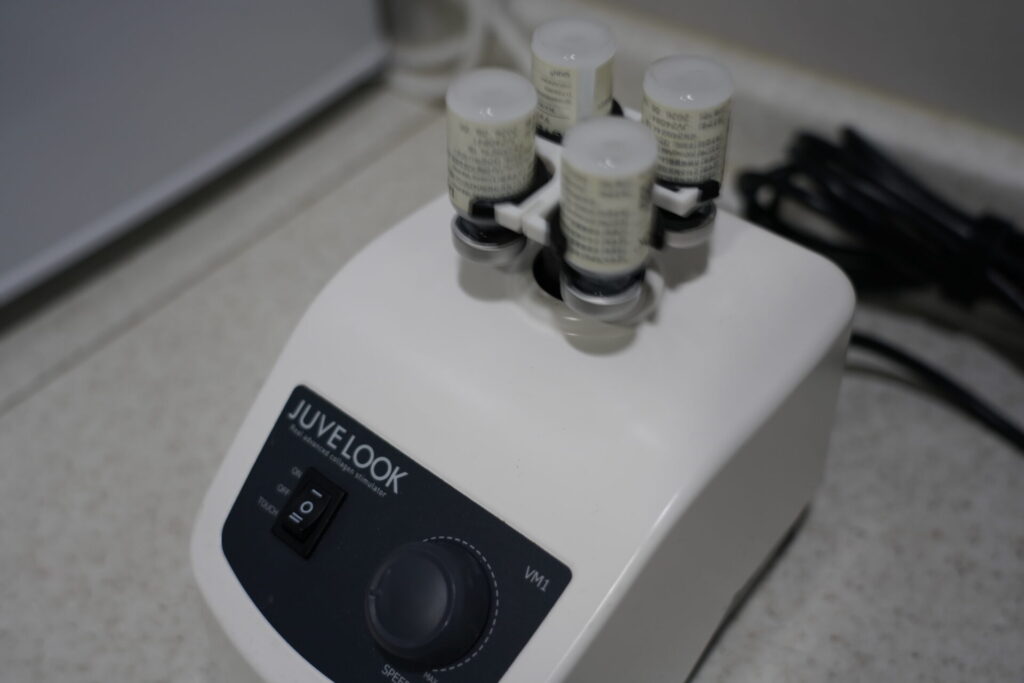
This is where the concept of a vial comes in. Simply put, a vial is a ‘bottle.’ In the context of the Juvereuc procedure, a vial refers to a unit for counting the undiluted powdered Juvereuc product itself. Since this allows you to determine the amount of raw material being used, you can establish a clear standard. If a 4cc volume using 0.5 vials and a 10cc volume using 1 vial are the same price, which one is more economical? Although the latter has a larger volume, the former has a higher concentration, making the 4cc procedure more advantageous in terms of cost.
Jubelook capacity, is more the merrier?
So, when considering the dosage of Juvelook, does that mean you should unconditionally choose the option with the highest concentration? Absolutely not. While it may be a reasonable choice in terms of price alone, the most important thing is, above all, the result. Just as the saying goes, “too much of a good thing is bad,” injecting Juvelook at an excessive concentration can also cause side effects such as nodules.
If it is too diluted, the effect diminishes, but if it is too concentrated, the risk is high. You must be feeling frustrated wondering what you are supposed to do. In fact, it is true that this is a difficult issue for an individual patient to judge on their own. As mentioned earlier, the formulation ratio of Juvelook varies from hospital to hospital, so it is essentially a secret recipe. Furthermore, the appropriate dosage inevitably varies depending on the area being treated and the individual’s skin condition.
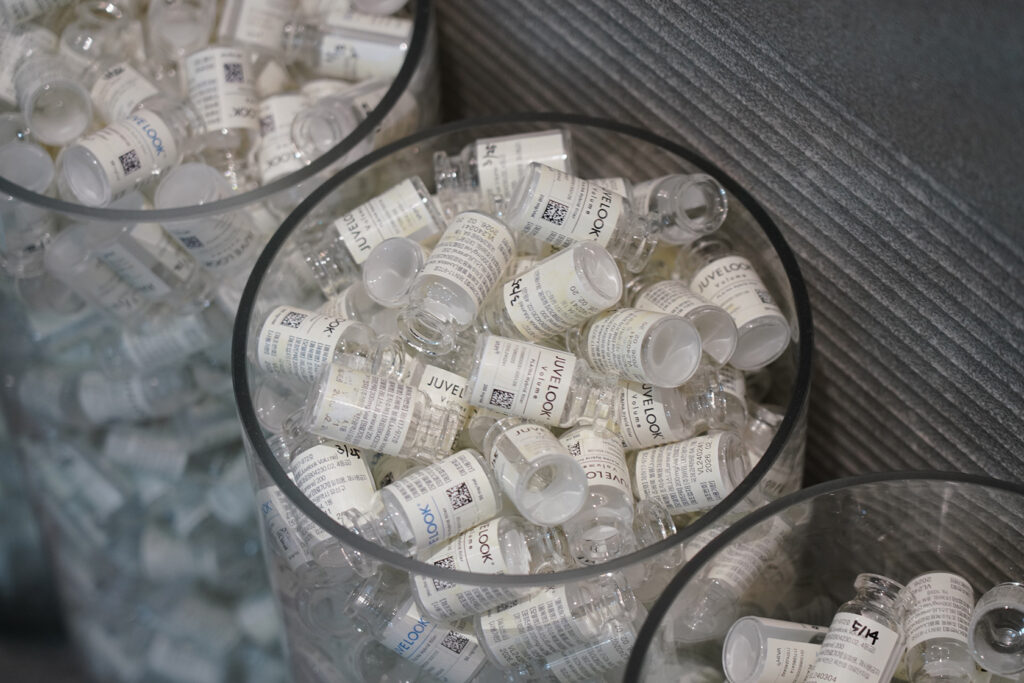
Ultimately, the most important thing is to choose a clinic with sufficient experience and know-how regarding the Juvereuk procedure. If a clinic directly or indirectly discloses the number of procedures performed to date, or holds titles related to Juvereuk, it is likely a place you can trust to some extent. We hope you have a satisfying treatment experience where the effectiveness is high while the possibility of side effects is minimized, through the hands of a trustworthy expert.